OSHA PSM Enforcement Policy – 2024
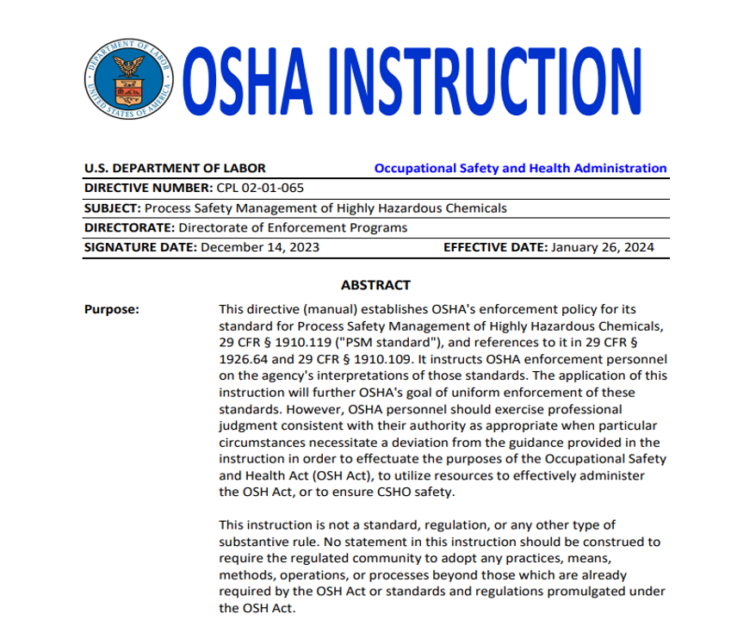
OSHA Instruction CPL 02-02-045A (REVISED), September 13, 1994, has been cancelled and superseded by this instruction. OSHA’s PSM Covered Chemical Facilities National Emphasis Program (CPL 03-00-021) describes an OSHA National Emphasis Program (NEP) for inspecting facilities with highly hazardous chemicals (HHCs) in amounts at or greater than the threshold quantities listed in 29 CFR § 1910.119. Significant modifications in this instruction include:
- Removal of the Appendix A PQV Audit Checklist in the OSHA Instruction CPL 02-02-045A (REVISED), September 13, 1994
- Incorporation of existing OSHA PSM enforcement policies into a question and response format.
OSHA promulgated the PSM standard in 1992 in response to the numerous catastrophic chemical manufacturing incidents that occurred worldwide. These incidents stimulated broad recognition that handling highly hazardous chemicals (HHC), flammables, and explosives could lead to incidents that may occur infrequently but, due to their catastrophic nature, often result in multiple injuries and fatalities. Since the promulgation of the standard, numerous questions have been submitted and compliance guidance provided to industry on the application of the standard. The below is a compilation of questions, references to applicable Letters of Interpretation or standard interpretations addressing the question, and current OSHA compliance guidance. The below is formatted as a question and response, with some questions having a scenario preceding it to provide context for the question and response. Inside the directive has hundreds of questions, OSHA’s answers, and URL for reference of interpretations and case law. See below for three examples.
Example Question 1: Processes A and B are located on the same contiguous property and are owned and operated by affiliated employers. Process A contains a HHC and is owned and operated by Company A. Process B is owned and operated by Company B. Company B distributes the HHC. Process A and B are interconnected and contain the same HHC. Process A contains greater than the TQ and Process B contains less than the TQ. QB-25: Are Process A and B enforceable PSM-covered processes?
Response 1: Yes. Since the affiliated employers have interconnected processes that contain greater than a TQ at a contiguous location (i.e., on site in one location), it is PSM covered.
Example Question 2: Does the employer need to determine adequacy of safeguards in the PHA?
Response 2: Yes. The PHA must identify, evaluate, and control the hazards involved in the process in accordance with Section 1910.119(e)(1). Therefore, if the employer takes credit for safeguards in the PHA to prevent and mitigate a release of a HHC, then those
safeguards must be effective. Likewise, the employer must evaluate the consequences of failure of engineering and administrative controls in accordance with Section 1910.119(e)(3)(iv). For example, an employer determines during a PHA that its electrical utility system needs to be relied upon for the safe operation of their PSM-covered process. The employer must determine that a safeguard such as an uninterruptible power supply (UPS) is needed to prevent loss of electrical power to the process equipment. In this example, the employer would need to determine effectiveness of the UPS (i.e., a safeguard) by verifying that the on-site electrical distribution system, from the main power supply and the UPS, would not be compromised by a fire, explosion, or damaged for some other reason. For example, if the electrical utility cannot function to safely operate the process because the electrical distribution system is compromised, the UPS safeguard would not be a credible safeguard for the process. In addition, the employer must ensure the reliability of the UPS system through inspection, testing and maintenance in accordance with Section 1910.119(j). Therefore, the employer must ensure effectiveness of safeguards, including parts of the process which do not contain HHCs such as utilities, to ensure they are designed, installed, operated (training and procedures), changes are reviewed and authorized, and inspected/tested/maintained to meet the PSM standard.
Example Question 3: Is a specific method of testing required to make sure that operators understand the training provided to them under Section 1910.119(g)?
Response 3: No. PSM is a performance-based standard therefore, the employer must determine if employees have understood the training provided and are capable of adhering to the current operating procedures as developed and implemented for the process. This could include the administration of a written test, or other means of ascertaining comprehension of the training, such as on-the-job (OTJ) demonstrations, etc., are acceptable, if the method of providing the verification of understanding is adequately documented in accordance with Section 1910.119(g).
To get a quote for us to come onsite and provide a private PSM training course see this link. To see our current schedule see this link.
Ammonia Refrigeration Training Solutions – ARTS