
PSM / RMP Training
Ammonia PSM (Process Safety Management) and RMP (Risk Management Programs) required by OSHA and EPA is essential training for all whom operator or make decisions that affect the ammonia refrigeration system today or in the future. With the new OSHA and EPA proposed changes, today is a perfect time to get certified and stay ahead of compliance requirements. Many participants titles include:
- Ammonia Technicians
- Refrigeration Managers / Supervisors
- PSM Managers
- PSM Coordinators
- Safety
- EHS
- Training Managers
- Engineers
- Contractors
- Plant Level Management
- Cooperate
- HR Manager
- Project Planners / Schedulers
- Asset Managers
ARTS PSM course covers much more aspects than just PSM/RMP and is the industry standard for the basis of well built, integrated and implemented programs. PSM/RMP is culture and when actions support your values a thriving culture emerges. Is your PSM team ready to win the compliance super bowl? We call this certification R-717 PSM/RMP.
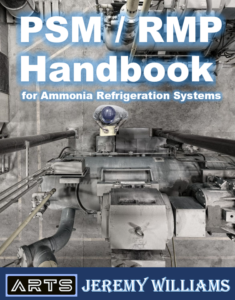 The class in a person is a 4-day session and online you have six months to complete. Candidates whom score well on ARTS certification test provided at the end of the course tend to do well on IIAR certifications as well. All ARTS certifications are active for a three window and carrier of those credentials must follow all company and regulator procedures. The R-717 PSM/RMP course entails a copy of the latest edition industrial ammonia PSM/RMP Handbook for Ammonia Refrigeration Systems. This book is for the student to keep and reference not only during the class but their entire career. Topics to be covered are as follows:
Register Today @ this link
Subjects of PSM certification:
Chapter 1 – What is Process Safety?
The First Five Questions – Page 1
The Goal of PSM – Page 4
Have You Ever Read the PSM Law? – Page 7
The PSM Manager – Page 8
The Birth of Regulations – Page 10
OSHA / EPA – PSM/RMP Shalls – Page 15
What is Safety? – Page 16
What is a Process? – Page 16
What is Process Safety? – Page 20
What is Environmental Safety? – Page 25
What is Personal Safety? – Page 25
The Safety Triangle – Page 25
The Elements of PSM/RMP – Page 26
The Acronyms of PSM – Page 27
The Interconnectivity of PSM – Page 28
The Doors of PSM/RMP – Page 30
Major Ammonia Accidents That Have Affected PSM – Page 33
Best Practices / RAGAGEP – Page 42
Join Trade Associations – Page 49
Self-Education / Certification Goals / Career Goals – Page 50
Chapter 1 – Self Assessment – Page 51
Chapter 2 – R-717 Safety
Hazard Communication Standard (HAZCOM) – Page 55
What is NH3? – Page 56
How is NH3 Produced? – Page 57
Where is NH3? – Page 57
What is NH3 Used For? – Page 58
What is not Compatible with NH3? – Page 59
Does NH3 cause Cancer? – Page 60
R-717 Behavior Under Atmospheric Conditions – Page 60
NH3 – The Inorganic Refrigerant – Page 61
Ammonia Specialized Numbers & Symbols – Page 62
NH3 Classifications – Page 64
Industrial Grade NH3 vs. Refrigerant Grade vs Agricultural Grade NH3
– Page 66
Contaminated NH3 – Page 67
How much NH3 should a Facility Have? – Page 69
Accidental Releases and Reporting Loss Requirements for NH3 – Page 70
Chemical PPM and Percentages Conversions – Page 76
NH3 – STEL – Page 81
NH3 – PEL – Page 81
The Ammonia Respirator – Page 82
NH3 – IDLH – Page 89
Respiratory Protection and Emergency Escape Requirements – Page 91
Respirators – Maintenance / Care / Inspection / Repair – Page 92
Common Injuries with NH3 Exposure – Page 94
NH3 Flammability Concerns – Page 95
Finding Small NH3 Leaks – Page 97
Liquids on Liquids – Page 99
Water and NH3 Gas – Page 100
NH3 Decontamination – Page 102
PPE and Tools – Page 107
NH3 Hoses – Page 108
Trapping Liquid NH3 – Page 109
Max Storage Capacity of Isolated Ammonia Vessels – Page 111
Variations in NH3 Safety Data Sheets – Page 113
Personal Close Calls with NH3 – Page 113
Chapter 2 – Self Assessment – Page 115
Chapter 3 – Becoming Aware
Unique PSM/RMP Definitions – Page 119
EPA’s Unique Release Analysis Requirements – Page 123
The EPA RMP Registration / Updates / State Plans – Page 128
EPA’s Unique Record Retention Requirements – Page 131
EPA Tier II Submittal – Page 132
Government Inspections – Page 135
What is my Liability / Accountability / Responsibility? – Page 138
Can I Be Interviewed During an Inspection? – Page 139
OSHA and EPA Regions – Page 140
General Duty – Page 142
The EPA and General Duty Citations – Page 147
PSM/RMP Nomenclature and Code References – Page 150
EPA Level 3 RMP Inspection – Page 151
OSHA Voluntary Protection Programs – Page 158
OSHA Inspections, Citations, and Proposed Penalties – Page 159
OSHA’s Infromal Conference – Page 163
Good Faith – Page 164
Instance-by-Instance (IBI) Violations – Page 165
Severe Violator Enforcement Program (SVEP) – Page166
OSHA PQV Inspections – Page 169
Management Systems – Coaches, Players, and Fans – Page 170
Element Guidelines – Page 177
Recurring Timelines and Schedules – Page 184
Crossing I’s and Dotting T’s – Page 190
If Not Written, It Did Not Happen – Page 190
OSHA NEP Inspections – Page 191
BP – Texas City Failures – Page 193
NEP Inspections – Document Request – Page 197
OSHA NEP Inspections – Walk-Through – Page 198
CHEMNEP Citation Breakdown? – Page 199
Obama’s Executive Order 13650 – Page 200
EPA Enforcement Alert – Anhydrous Ammonia at Refrigeration Facilities Under Scrutiny by US EPA – Page 202
OSHA RAGAGEP PSM Enforcement Considerations – Page 205
EPA Enforcement Alert – Risk of Chemical Accidents During Startups
– Page 207
The Actual Citations, 1B’s, Evidence, and Photos – Page 208
Real Cost for a Regulatory Citation – Page 210
Homeland Security Requirements – Page 211
Chapter 3 – Self Assessment – Page 214
Chapter 4 – Employee Participation
Employee Participation Overview – Page 219
OSHA Appendix – C & Employee Participation / PSM Team – Page 220
All other Affected Employees – Page 227
The OSHA PSM Regulations – Employee Participation – Page 229
The EPA RMP Regulations – Employee Participation – Page 229
The CalARP Regulations – Employee Participation – Page 229
Access to the Program – Page 230
Stop Work Authority – Page 231
Unpreventable Employee Misconduct – Page 232
Employee Participation Forms / Documents – Page 234
Employee Participation Best Practices – Page 236
OSHA NEP Document Requests – Page 237
Industry Citations / Violations – Page 237
Chapter 4 – Self Assessment – Page 240
Chapter 5 – Process Safety Information
Process Safety Information Overview – Page 243
OSHA Appendix – C & Process Safety Information (PSI) – Page 244
The OSHA PSM Regulations – Process Safety Information – Page 246
The EPA RMP Regulations – Process Safety Information – Page 247
The CalARP Regulations – Process Safety Information – Page 248
Chemical Information – Page 249
Process Chemistry – Page 251
Maximum Intended Inventory – Page 252
Safe Upper and Lower Limits – Page 254
Evaluation of Consequences of Deviation – Page 255
Materials of Construction – Page 256
Flow Diagrams – Page 260
Plot Diagram and Narrative Description – Page 261
Materials and Energy Balance – Page 262
Electrical Classification – Page 263
Ventilation System Design – Page 264
Relief System Design and Design Basis – Page 265
Where Should the Discharge of the Relief Valves by Plumbed To? – Page 267
What is a Diffusion System? – Page 269
What is an EPCS? – Page 269
What is a Fireman’s Dump? – Page 270
Safety Systems – Page 271
Design Codes and Standards Employed – RAGAGEP – Page 272
Process Safety Information Best Practices – Page 275
Valve Tagging / Equipment Labeling – Page 277
Accessibility to Valves – Page 278
Pipe Labels – Page 279
Pipe and Insulation Color – Page 282
What Should be on the Doors to an Engine Room? – Page 283
OSHA NEP Document Requests – Page 285
Industry Citations / Violations – Page 286
Chapter 5 – Self Assessment – Page 295
Chapter 6 – Process Hazard Analysis
Process Hazard Analysis Overview – Page 297
Who Should have Access to the Engine Room? – Page 299
Hierarchy of Controls – Page 300
Sections to the PHA – Page 301
OSHA Appendix – C & the PHA – Page 303
The OSHA PSM Regulations – Process Hazard Analysis – Page 306
The EPA RMP Regulations – Process Hazard Analysis – Page 308
The CalARP Regulations – Process Hazard Analysis – Page 310
Risk vs Hazard – Page 311
1910.119(e)5 – Findings and Recommendations – Page 313
PHA Revalidation – Update vs Redo – Page 317
Identification of Previous Incidents – Page 319
PHA Resources – Page 320
PHA Teams – Page 321
What-if / What-if Checklist – Page 322
Hazard and Operability Study (HAZOP – Page 324
Facility Siting – Page 326
Human Factors – Page 331
Major MOCs and PHAs – Page 333
Process Hazard Analysis Best Practices – Page 334
OSHA NEP Documentation Requests – Page 334
Industry Citations / Violations – Page 335
Chapter 6 – Self Assessment – Page 343
Chapter 7 – Operating Procedures
Operating Procedures Overview – Page 345
OSHA Appendix – C & Operating Procedures and Practices – Page 347
The OSHA PSM Regulations – Operating Procedures – Page 349
The EPA RMP Regulations – Operating Procedures – Page 350
The CalARP Regulations – Operating Procedures – Page 351
Procedural Development Guidance – Page 351
IIAR 7 – Procedural Development Layout – Page 354
SOP Accessibility – Page 355
SOPS – Reviewed and Certified – Page 356
Operating Phases and Task Flows – Page 357
Efficiency / Operating / Emergency / Shutdown / Design – Limits – Page 360
Safe Work Practices – Page 364
Quality Control Systems – Page 365
Operating Procedures Best Practices – Page 373
OSHA NEP Documentation Requests – Page 373
Industry Citations / Violations – Page 374
Chapter 7 – Self Assessment – Page 380
Chapter 8 – Mechanical Integrity
Mechanical Integrity Overview – Page 383
Housekeeping – Page 385
OSHA Appendix – C & Mechanical Integrity – Page 391
The OSHA PSM Regulations – Mechanical Integrity – Page 394
The RMP Regulations – Mechanical Integrity – Page 395
The CalARP Regulations – Mechanical Integrity – Page 396
Inspection / Testing / Maintenance Schedules – Page 396
1910.119(j)5 – Equipment Deficiencies – Page 398
Annual Inspection and Testing – Page 399
NDT (Non-Destructive Testing) – Page 402
Written Procedure / Training – Page 406
Oil Draining Practices – Page 409
Mechanical Integrity Forms / Documents – Page 410
Buddy Systems – Page 411
Mechanical Integrity Best Practices – Page 411
OSHA NEP Documentation Requests – Page 412
Industry Citations / Violations – Page 412
Chapter 8 – Self Assessment – Page 420
Chapter 9 – Contractors
Contractors Overview – Page 423
OSHA Appendix – C & Contractors – Page 424
The OSHA PSM Regulations – Contractors – Page 425
The EPA RMP Regulations – Contactors – Page 426
The CalARP Regulations – Contractors – Page 427
Two Buckets of Responsibilities – Page 427
Contractor Forms / Documents – Page 428
Third-Party Contractor Management Supplier – Page 435
Consult / Facility Requirements Training – Page436
Building Tenant – Lessor and Lessee – Page 437
29 CFR 1926? – Page 438
OSHA NEP Documentation Requests – Page 438
Industry Citations / Violations – Page 439
Chapter 9 – Self Assessment – Page 441
Chapter 10 – Training
Training Overview – Page 443
OSHA Appendix – C & Training – Page 445
The OSHA PSM Regulations – Training – Page 447
The EPA RMP Regulations – Training – Page 447
The CalARP Regulations – Training – Page 448
HAZCOM vs PSM/RMP Training Documentation – Page 448
Difference Between a Roundsmen / Operator / Mechanic / Technician?
– Page 449
Title vs Function – Page 450
ARTG – Ammonia Refrigeration Training Guideline – Page 451
Ammonia Operator 1, 2, 3,…. Training Best Practices – Page 454
RETA – CARO / CIRO / CRST / RAI Certifications – Page 456
Online / Computer Based Training – Page 457
Grandfathering Operators – Page 458
Refresher Training – Page 458
Training Types – Pros and Cons – Page 459
Skills / Knowledge Assessments – Page 460
Training Forms / Documents – Page 461
Training Best Practices – Page 467
OSHA NEP Documentation Requests – Page 468
Industry Citations / Violations – Page 468
Chapter 10 – Self Assessment – Page 471
Chapter 11 – Management of Change
Management of Change Overview – Page 473
OSHA Appendix – C & Managing Change – Page 475
The OSHA PSM Regulations – Management of Change – Page 476
The EPA RMP Regulations – Management of Change – Page 477
The CalARP Regulations – Management of Change – Page 477
3 Reasons to do an MOC – Page 478
Trippple P and MOC – Page 479
Major Change vs Minor Change – Page 480
Replacement in Kind (RIK) – Page 481
Replacement in Like – Page 482
Temporary Change – Page 482
Emergency Change – Page 483
Organizational Change Management (OCM) – Page 484
MOC Procedural Flow Chart – Page 485
MOC Logbook – Page 485
Reverse Engineering the MOC – Page 486
The Interconnectivity of MOC and the other Elements – Page 487
MOC Forms / Documents – Page 488
OSHA NEP Documentation Requests – Page 488
Industry Citations / Violations – Page 489
Chapter 11 – Self Assessment – Page 494
Chapter 12 – Pre-Startup Safety Review
Pre-Startup Safety Review Overview – Page 497
OSHA Appendix – C & Pre-Startup Safety Reviews? – Page 499
The OSHA PSM Regulations – Pre-Startup Safety Review – Page 500
The EPA RMP Regulations – Pre-Startup Safety Review – Page 500
The CalARP Regulations – Pre-Startup Safety Review – – Page 501
The PSI Changes that Trigger a PSSR – Page 501
PSSR Checklist – Page 502
Decommissioning Safety Review – DSR Checklist – Page 507
PSSR / DSR Checklist – Page 510
OSHA NEP Documentation Requests – Page 510
Chapter 12 – Self Assessment – Page 511
Chapter 13 – Incident Investigation
Incident Investigation Overview – Page 513
OSHA Appendix – C & Incident Investigation – Page 516
The OSHA PSM Regulations – Incident Investigation – Page 517
The EPA RMP Regulations – Incident Investigation – Page 518
The CalARP Regulations – Incident Investigation – Page 519
Incident Investigation Requirement Changed – 2017 & 2019 – Page 520
Other Accidental Release Considerations and Requirements – Page 521
Incident Investigation Methodologies – Page 522
Incident Investigation Reports – Page 524
OSHA Instruction – Near Misses and Actual Incidents – Page 526
Root Causes and Contributing Factors – Page 527
Incident Investigation Procedural Flow Chart – Page 528
Odor Investigations – Page 529
Incident Investigation Log – Page 530
Incident Investigation Best Practices – Page 530
OSHA NEP Documentation Requests – Page 531
Industry Citations / Violations – Page 531
Chapter 13 – Self Assessment – Page 534
Chapter 14 – Hot Work Permit
Hot Work Overview – Page 537
Importance of Hot Work – Page 539
OSHA Appendix – C & Non-Routine Work Authorizations – Page 540
The OSHA PSM Regulations – Hot Work Permit – Page 540
The EPA RMP Regulations – Hot Work Permit – Page 541
The CalARP Regulations – Hot Work Permit – Page 541
29 CFR 1910.252(a)? – Page 541
Hot Work Permits – On or Near the Process? – Page 543
Hot Work Responsibilities – Page 544
Hot Work Permit – Exemptions – Page 545
FM Global – Hot Work Permit Example – Page 546
FM Global – Fire Watch Guidance – Page 546
Hot Work Permit Expiration – Page 547
Hot Work Permit Record Retention – Page 547
Industry Citations / Violations – Page 548
Chapter 14 – Self Assessment – Page 549
Chapter 15 – Emergency Planning and Response
An Emergence for the HazWoper Regulations – Page 551
Emergency Planning and Response (EP&R) Overview – Page 555
Emergency Planning and Response Unique Definitions – Page 560
OSHA Appendix – C & EP&R – Page 562
The OSHA PSM Regulations – EP&R – Page 565
The EPA RMP Regulations – EP&R – Page 568
The CalARP Regulations – EP&R – Page 572
40 CFR 68.180 – RMP Reporting Requirements – Page 572
National Response Team’s Integrated Contingency Plan Guidance
“One Plan” – Page 573
41 U.S.C. 11003 – Legal Requirements of LEPC and Facilities – Page 574
When does HazWoper Apply? – Page 576
Procedures for Small Releases (Incidental Release) Pg 577
Controlled Ammonia Releases and SCBAs – Page 580
Basic Requirements for On-Site Emergency Responders – Page 581
Levels of PPE Protection and Considerations – Page 582
HAZMAT Training Curriculum Guidelines – Page 585
HAZMAT Responder Training Levels – Page 588
Ammonia HAZMAT Teams – Page 592
Ammonia HAZMAT Teams Equipment and PPE List – Example – Page 593
29 CRR 1910.37 – Maintenance, Safeguards, and Operational Features for Exit
Exit Routes – Page 594
Emergency Planning and Response Best Practices – Page 595
OSHA NEP Documentation Requests – Page 595
Industry Citations / Violations – Page 596
Chapter 15 – Self Assessment – Page 600
Chapter 16 – Trade Secrets
Trade Secrets Overview – Page 603
The OSHA PSM Regulations – Trade Secrets – Page 603
The EPA RMP Regulations – Confidential Business Information – Page 604
Chapter 17 – Compliance Audits
Compliance Audits Overview – Page 605
OSHA Appendix – C & Compliance Audits – Page 610
Compliance Audit Requirements Changed 2017 & 2019 – Page 612
The OSHA PSM Regulations – Compliance Audits – Page 613
The EPA RMP Regulations – Compliance Audits – Page 613
The CalARP Regulations – Compliance Audits – Page 614
Audit Frequency Best Practice – Page 614
Compliance Audit Best Practices – Page 615
OSHA NEP Documentation Requests – Page 615
Industry Citations / Violations – Page 616
Chapter 17 – Self Assessment
R-717 PSM/RMP
Register Today @ this link
Current Training Dates @ this link

Ammonia Operator Training Solutions